Pulling a series from PACS or storage usually yields hundreds of loose 2D slices with arbitrary filenames. To stack them into the correct 3D volume, we must decide how to order the slices.
What looks simple hides conflicting requirements from clinical workflow, rendering engines, and AI pipelines. Each sorting rule has valid use cases yet can break under other scenarios.
Conflicting Needs In Practice
Clinical reporting: Radiologists reference lesions by InstanceNumber (e.g., “lesion on slice X”). Most PACS viewers default to InstanceNumber, so clinical workflows expect this order.
AI standardization: Models prefer anatomical order (“head→feet” or the inverse), typically using SliceLocation or ImagePositionPatient. This yields consistent spatial patterns for learning.
Non‑standard scans: Oblique acquisitions (e.g., cardiac MR) or reconstructions (e.g., coronal reformat) may lack SliceLocation, and picking the proper component from ImagePositionPatient is non‑trivial.
3D rendering constraints: Engines like VTK assume right‑handed coordinates; incorrect ordering can mirror the volume (“left/right swap”).
Given these trade‑offs, we recommend right‑handed coordinate sorting as the default.
Why Default To Right‑Handed Order?
Least modification cost: Algorithms and renderers operate on full 3D arrays. Flipping or reordering requires heavy memory operations. Viewers, in contrast, can remap indices without moving pixels. Standardizing slices for compute‑heavy components keeps conversions lightweight downstream.
Alignment with rendering/ITK/VTK: Right‑handed ordering matches the dominant assumption in visualization toolkits, reducing extra transforms.
Standard compliance: It respects DICOM’s LPS+ convention.
Implementation
Read ImageOrientationPatient to obtain in‑plane X/Y direction vectors. Their cross product yields the normal. Project each ImagePositionPatient onto the normal and sort ascending; this guarantees a right‑handed stack.
Real‑World Caveat
A few vendors mis‑calibrate world coordinates and ship left‑handed geometry. Sorting alone cannot detect it and the result still mirrors. Detecting such anomalies requires additional analysis because metadata remains ambiguous.
Visual Verification
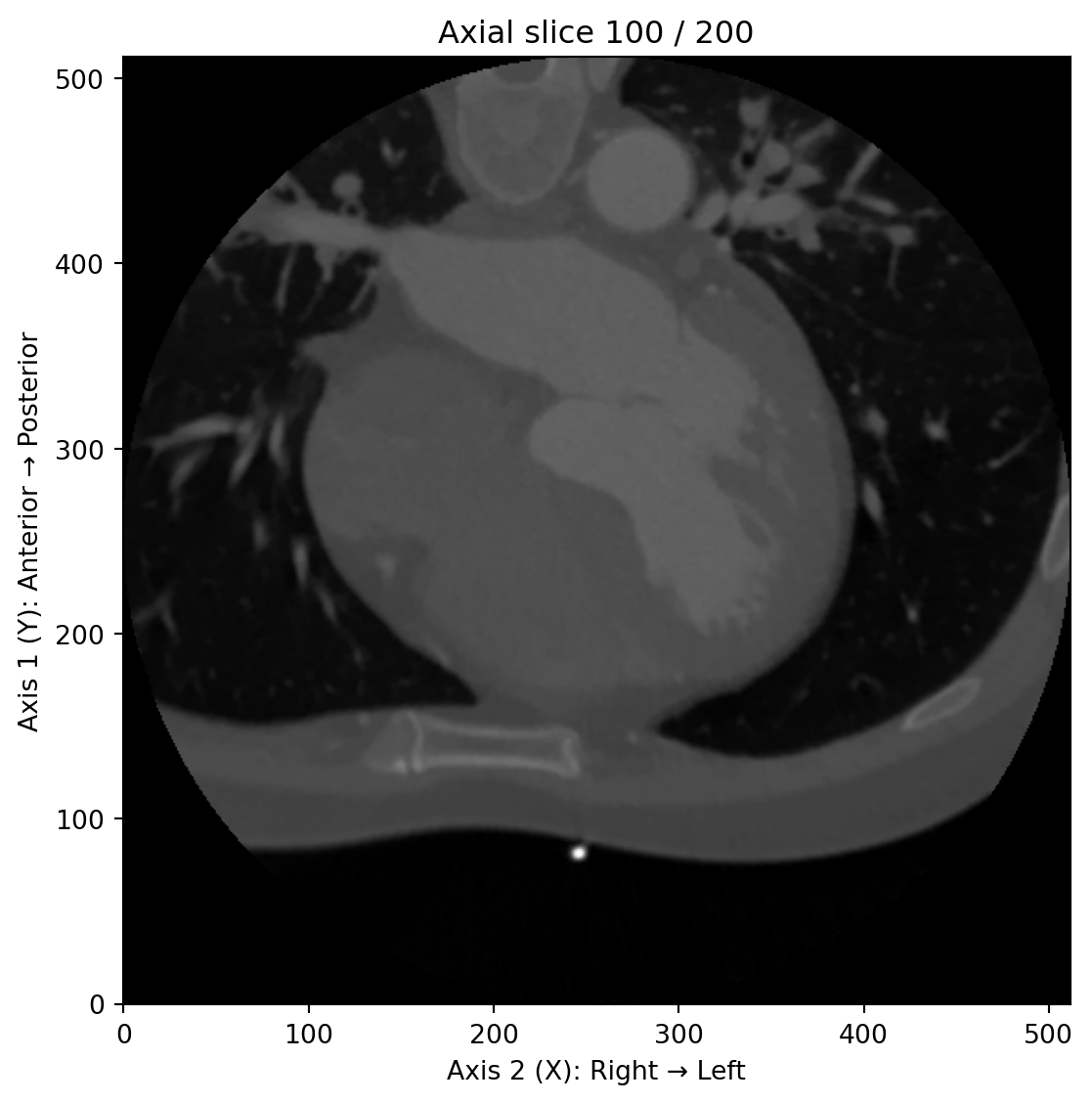
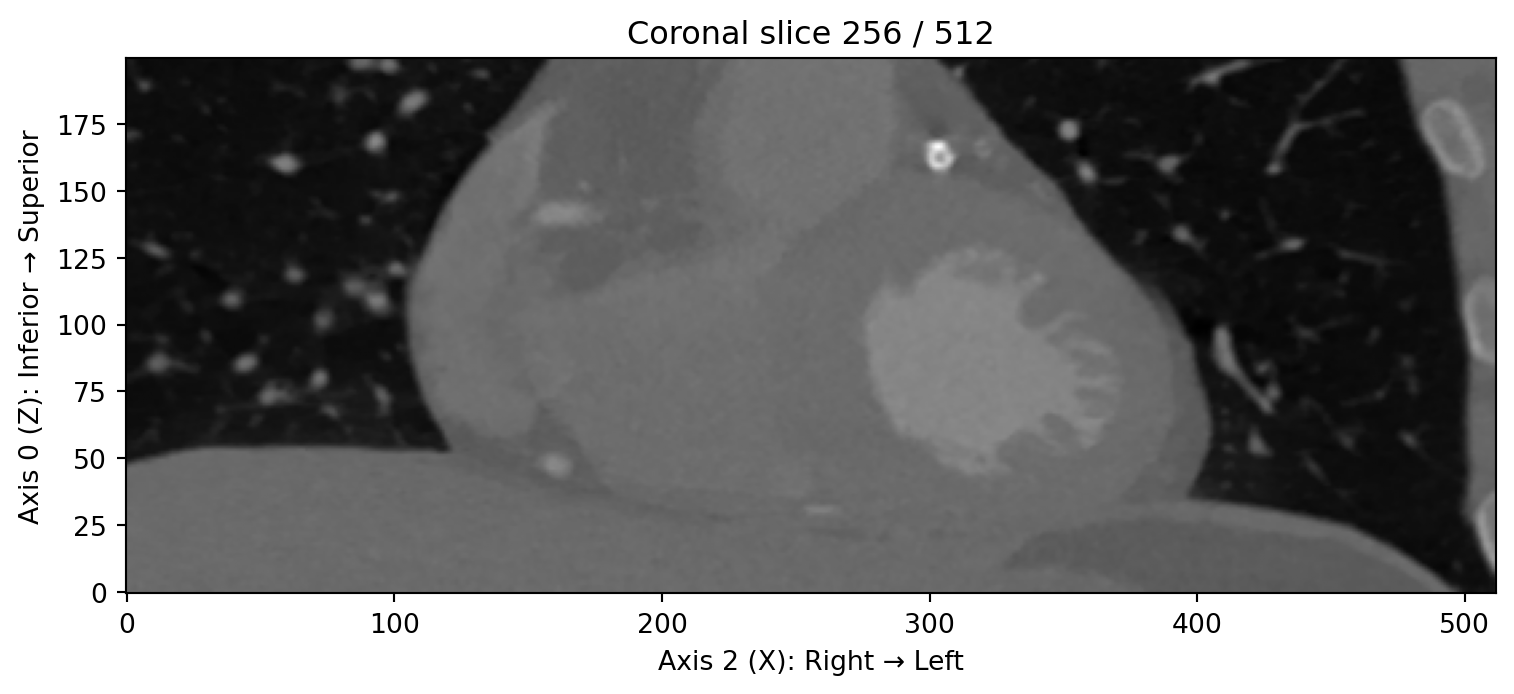
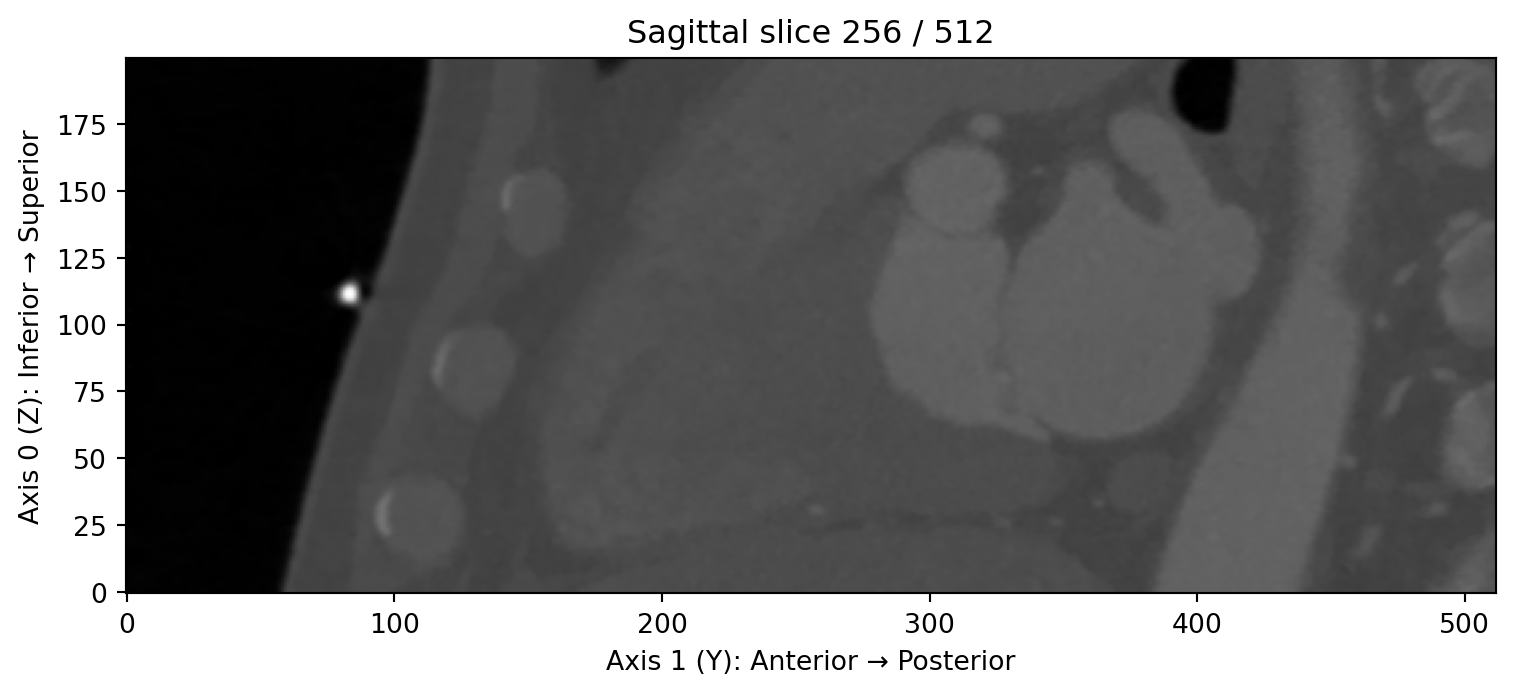
Plot axial/coronal/sagittal slices to confirm correct spatial arrangement.